Why Your Pool Jobs Look Profitable Until They Don't
By April Wu | InSphere Consulting
We get a version of the same call fairly regularly. A pool company owner usually doing somewhere between $1.5M and $5M in revenue, maybe more tells us their business feels like it's doing well. Crews are busy. The phone is ringing. They're not losing jobs on price. But when they look at the financials, the margin isn't where it should be, and they can't point to why.
That gap between "feels profitable" and "is profitable" is the thing we spend most of our time solving.
The pool installation and service industry is one of the harder operational environments we work in. You're running what is essentially a construction business and a service business at the same time, inside a compressed seasonal window, with a crew that's physically in the field and not sitting next to your accounting system. When you add up all the ways information can fall through the cracks, labor coded to the wrong job, materials that move between sites without a paper trail, invoices that go out late because nobody flagged a milestone, the cumulative hit to margin is almost always bigger than owners expect when they actually quantify it.

The Numbers Behind the Pressure
IBISWorld's 2026 industry analysis puts U.S. pool construction revenue at $24.8 billion. That's a market that has held up well, and demand remains strong. But industry-level revenue growth doesn't tell you much about what's happening at the individual company level, and in our experience, a growing top line can actually mask margin erosion for a surprisingly long time.
Skimmer's 2026 State of Pool Service Report which draws on data from over 35,000 users and more than a million pools paints a picture of an industry actively trying to get more operationally disciplined. The businesses that are winning right now aren't just chasing more jobs. They're focused on route density, higher-value repair work, and better back-office infrastructure. That's a meaningful signal. The competitive edge in this industry is increasingly about execution, not just sales volume.
Identifying Revenue Leakage in High-Volume Pool Service Operations
In the pool businesses we've worked with, the losses almost never come from one dramatic mistake. They come from three quiet, persistent problems.
Labor that doesn't get coded correctly or on time. Field crews are focused on the job in front of them, not on making sure their timesheet is submitted to the right project code by end of day. In a lot of companies, timesheets get filled out in bulk at the end of the week, or whenever someone in the office chases them down. By the time that labor hits your job costing report, it may be coded to the wrong project entirely, or sitting in a catch-all bucket that nobody reviews. You're making decisions about job performance based on incomplete data, and you won't know it until the job is done.
Materials that move without a record. Pool installations involve expensive equipment pumps, heaters, automation controllers and a constant stream of smaller consumables that individually don't seem worth tracking carefully. Both categories create the same problem: stuff gets used on a job and never recorded against it. The equipment piece is usually more dramatic when it surfaces. A $2,400 heater that got pulled from Job A and installed on Job B because the schedule moved up shows up as a phantom asset in your inventory and an unrecorded cost on B's ledger. The consumables piece is quieter and, in aggregate across a full season, often just as costly.
[Get Your Free Odoo Implementation Checklist]
Reconciliation that's always running behind. If your field activity, purchasing, and billing each live in different places separate software, spreadsheets, email threads somebody in your office is manually pulling those pieces together. That takes time. It introduces errors. And it means your financial picture of any given job is always lagging behind what's actually happening on that job. By the time a cost overrun shows up in your reporting, you've often lost the window to do anything about it. You're documenting a problem, not managing one.
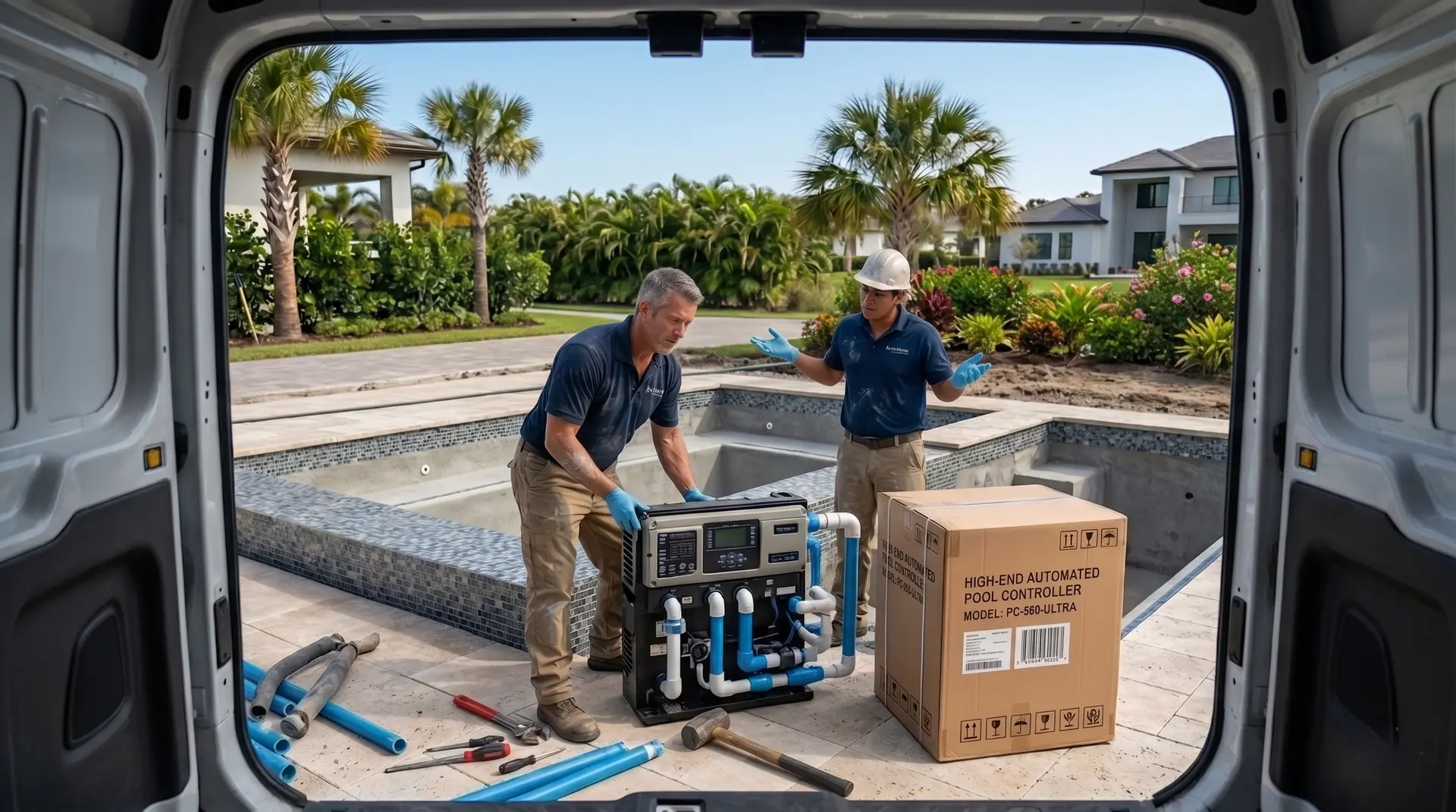
Digital Transformation: Aligning Field Ops with GAAP Financial Integrity
We're careful not to oversell ERP implementation as a fix-everything solution, because it isn't one. What it does is remove the structural conditions that let these problems persist.
When field labor, purchasing, billing, and accounting are connected in a single workflow not synced nightly between three tools the data moves with the work. That changes the timing of your visibility, which is the variable that actually drives better decisions.
For pool companies specifically, that shows up in a few ways that matter:
You can see job margin while the job is still active. This sounds basic, but most pool companies we talk to are discovering job-level cost problems at month-end close or later. When labor and materials roll into project reporting in real time, a project manager or owner can see that a phase is running over while there's still work left to do. That's a completely different management posture.
Phase-level tracking becomes something you actually do, not just intend to do. Pool construction moves through defined phases: excavation, plumbing rough-in, equipment set, interior finish, startup and commissioning. If those phases are set up in your system and your team codes costs to them consistently, you can see which phases are tracking to estimate and which aren't. That improves execution on the current job and improves your estimating on the next one. Over time, it compounds.
Billing follows actual progress instead of whoever remembers to send an invoice. This is one of the most straightforward cash flow improvements we see. Pool companies routinely under-bill during construction because invoicing is driven by individual initiative rather than system triggers. When milestone billing is connected to project status, invoices go out when work is completed not when someone gets around to it.
Purchase orders create a control point that actually works. When purchasing runs through an approval workflow tied to job cost codes, materials can't be acquired and used without being recorded against a project. This isn't about distrust of your field team. It's about closing a process gap that creates accounting problems regardless of intent.
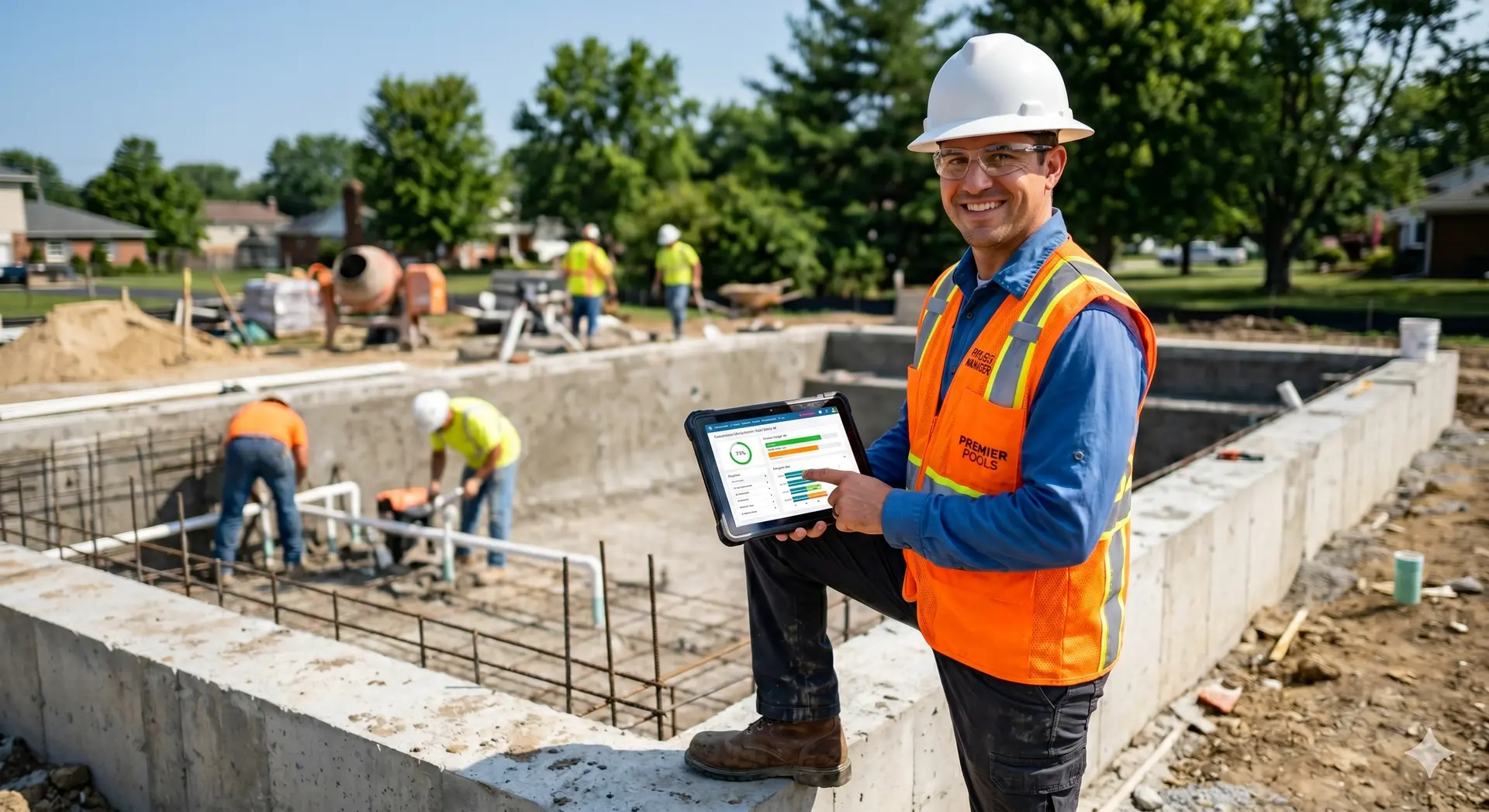
What This Means If You're Running One of These Businesses
The data from Skimmer and IBISWorld is consistent with what we see on the ground: the pool industry has real demand and real margin pressure at the same time. The businesses that will be in the strongest position over the next few years are the ones that can execute profitably, not just win jobs.
If your financial reporting consistently tells you a different story than your gut sense of how jobs are going and especially if the financial story is worse that gap is worth taking seriously. It doesn't close on its own as you grow. If anything, more volume through a broken process creates more exposure, not less.
We work with pool installation and service companies on exactly this problem: connecting field operations to financial control in a way that reflects how your crews actually work and how your office actually processes transactions. The goal isn't cleaner software. It's current, accurate job-level data so you can manage your business in real time instead of reconstructing it after the fact.
Ready to find your gaps? Book a System Health Check with InSphere Consulting, and we'll show you exactly where your field-to-finance disconnect is and what it’s likely costing your bottom line.
[Schedule a System Health Check] or Call Us +1 (312) 203-6834
InSphere Consulting works with pool service and construction companies to align field operations with financial systems, ensuring your growth never outpaces your visibility. Our engagements with pool professionals span weekly maintenance routes, high-end equipment installations, and full-scale renovations.
Sources:
IBISWorld, Swimming Pool Construction in the US Industry Analysis, 2026