Why Your Plumbing Jobs Are Profitable in the Field but Not on the Books
By April Wu
With 6 years in ERP consulting and 50+ U.S. client engagements under her belt, April Wu knows what makes or breaks an implementation. As Founder & CEO of InSphere Consulting, she helps companies cut through the complexity and get their systems working for them.
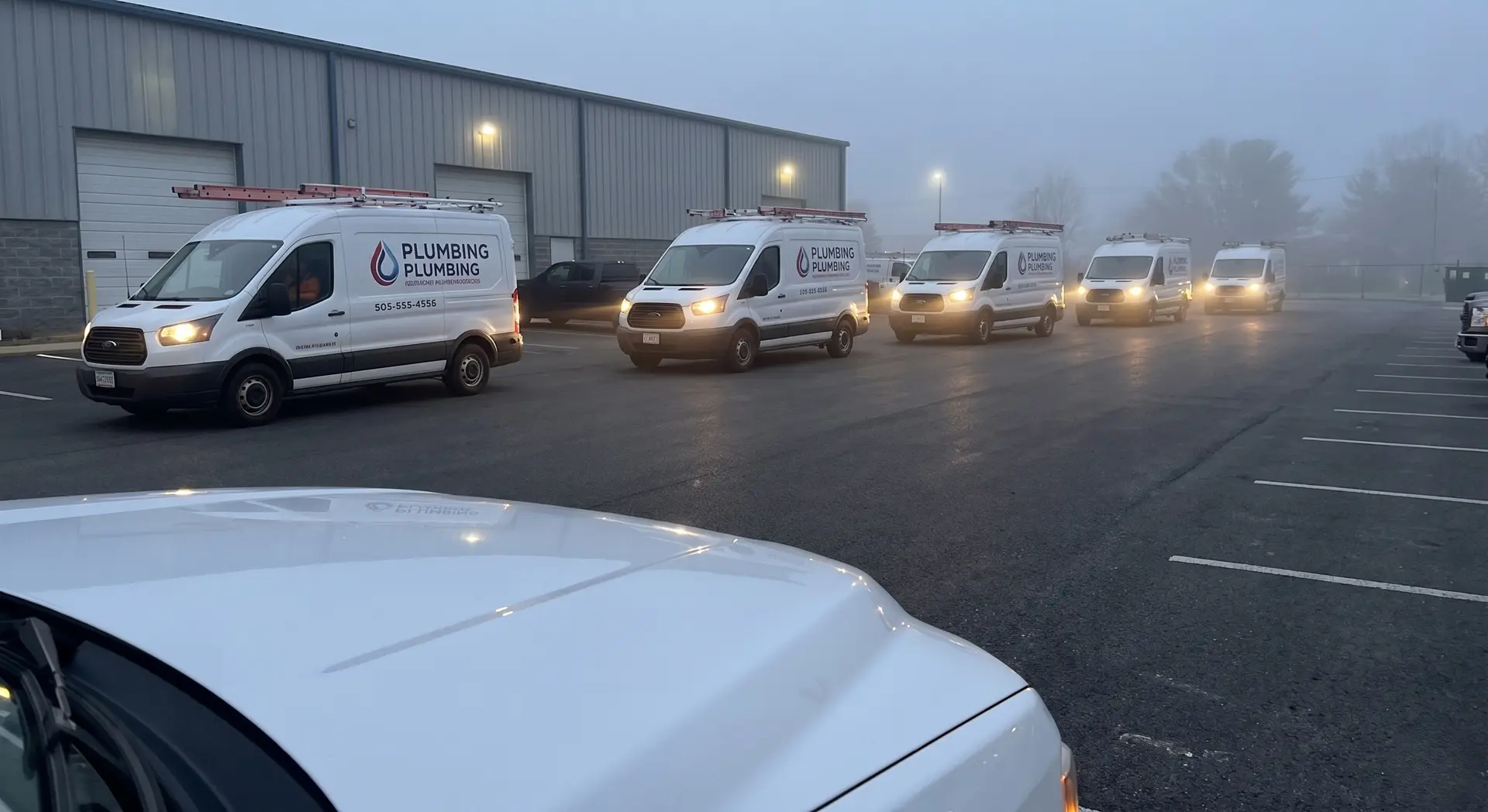
We get a version of the same call more often than you'd expect. A plumbing company owner usually somewhere in the range of a few million in annual revenue, sometimes more tells us the business feels like it's moving in the right direction. The vans are running, dispatch is busy, maintenance contracts are renewing, and the field team is staying active. But when they sit down with their CFO or Controller to go through the numbers, the margin picture doesn't match what they know is happening on the ground.
That gap between "the operation feels healthy" and "the financials confirm it" is where most of the problem lives. It's also where most of the damage accumulates quietly, over months, until it isn't quiet anymore.
Plumbing is one of the most operationally demanding businesses in the trades. You're running a service business, a logistics operation, and a job-costed project environment simultaneously. Technicians are mobile assets carrying inventory. Dispatchers are solving real-time scheduling problems. The back office is trying to reconcile work completed in the field against billing and accounting systems that almost always lag behind the work itself. The bigger the business gets, the harder it is to keep those pieces aligned.
The Pressure Behind the Numbers
The industry context matters here because it helps explain why this disconnect is so persistent.
IBISWorld estimates that U.S. plumbing industry revenue has continued to expand, reflecting steady demand for essential repair work, emergency callouts, and recurring service activity. But strong industry-level revenue growth doesn't tell you much about what's happening at the job level inside a given company and in our experience, a growing top line can mask margin erosion for a surprisingly long time before it shows up in a way that's hard to ignore.
The workforce side adds pressure too. The U.S. Bureau of Labor Statistics projects continued demand for plumbers, pipefitters, and steamfitters over the coming decade, driven by replacement needs and sustained construction activity. That means most contractors are trying to do more with a labor pool that remains tight which raises the cost of every misplaced hour and every unbilled part.
Then there's the structural piece. TheFederal Reserve Bank of Richmond found that U.S. construction labor productivity has declined by more than 30 percent since 1970, even as overall U.S. productivity has climbed sharply over the same period. That's not an abstract data point. It's a signal that the trades still rely heavily on manual coordination, fragmented workflows, and back-office processes that weren't built for real-time field execution. The plumbing companies that scale well aren't the ones winning the most work they're the ones whose operational systems can keep pace with the work itself.
Where the Disconnect Shows Up
In the plumbing businesses we work with, the losses almost never come from one big mistake. They come from three quiet, persistent problems.
Labor that can't be cleanly assigned to a job. Plumbing technicians rarely spend an entire day on a single clean assignment. A morning drain clearing might be followed by a same-day emergency leak, a parts run, and a warranty callback before the shift ends. When those hours get reconstructed later from memory, text messages, or a late timesheet, the result is usually inaccurate time coded to the wrong job, parked in overhead, or lost entirely. The job cost report ends up telling a different story than the work that was actually performed.
Inventory that moves faster than the paperwork. Plumbing vans carry both low-cost consumables and high-value equipment. Fittings, valves, and couplings disappear into jobs quickly. Higher-ticket items, water heaters, pumps, filtration units create a bigger problem when they're transferred between vehicles or installed without a clean record. If inventory movement isn't captured at the moment it happens, the business loses visibility into where the asset went, what it cost, and which job it should have been charged to.
Profitability discovered too late to change anything. ServiceTitan's analysis of plumbing ERP challenges points to a familiar pattern: disconnected systems create delayed invoicing, poor visibility, duplicated data entry, and billing problems that drag down margin over time. By the time someone in the office reconciles the paperwork, the job is complete, the technician has moved on, and the margin issue is already baked in. You're documenting a problem, not managing one.
These aren't personality problems. They're process problems.
Why More Software Can Make It Worse
When gaps like these surface, the natural reaction is to add tools. A scheduling app here, a dispatch platform there, a separate invoicing system, a spreadsheet to bridge everything else. Those tools can help in isolation. But when they don't share data cleanly, the problem doesn't disappear; it spreads across more systems.
Now the same information exists in three places, and somebody still must reconcile it by hand. Office workload doesn't go down. It just gets more fragmented.
The more effective path is a system where field activity, inventory, billing, and accounting all flow from the same source of truth. That's what eliminates re-entry, shortens the billing cycle, and gives leadership a financial picture that reflects what actually happened on the job not a reconstruction of it assembled a week later.
Get Your Free Odoo Implementation Checklist
What Changes When the System Works
When field operations and accounting are aligned, the business functions differently in ways that show up at the executive level.
You can see job margin while the job is still active. This sounds basic, but most plumbing companies don't discover margin problems until month-end close or later. When labor, parts, and travel costs are captured in real time, a service manager can spot a job trending over budget while there's still time to adjust scope or scheduling.
Inventory becomes controllable instead of invisible. When every van is treated as a tracked location and transfers are logged properly, managers can see where stock is, what's in use, and what's been consumed by specific jobs. Fewer mystery losses. Fewer emergency replenishment runs. Better purchasing decisions.
Billing follows completion, not memory. When job completion in the field automatically triggers invoice preparation, the gap between work finished and work billed narrows significantly. Delayed invoicing is one of the fastest ways to weaken cash flow in a service business, and it's almost entirely a process problem.
Emergency dispatch becomes a coordination advantage instead of a scramble. With a unified view of technician status, location, and qualifications, dispatch can assign the right person faster and cut the back-and-forth that adds unnecessary time to response.
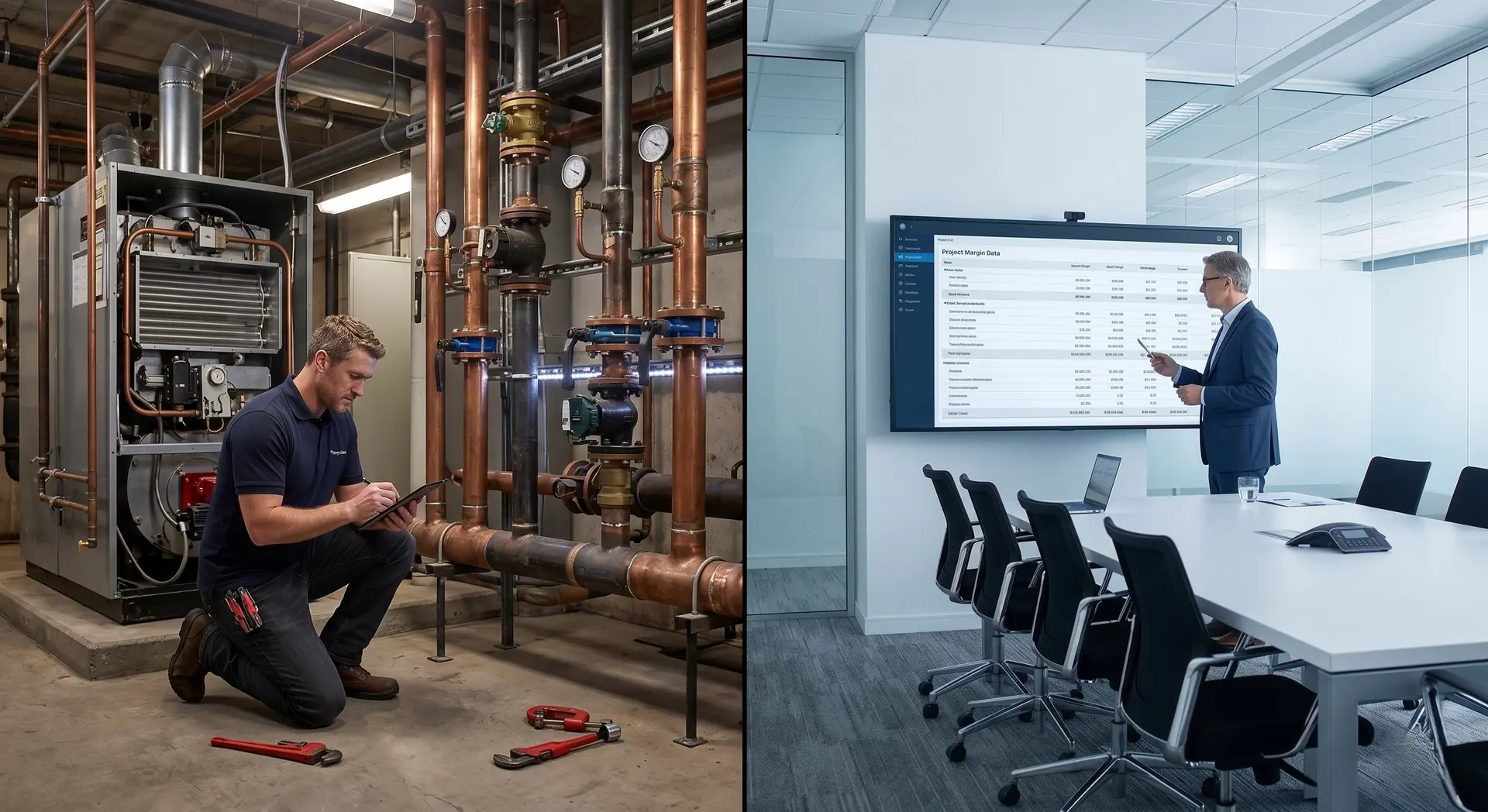
Financial reporting becomes a management tool. When operational data, job costing, inventory, and billing are all connected, your Controller and CFO aren't reconstructing the month after the fact. They're looking at a live picture of the business one that supports decisions while there's still time to act on them.
A Fast Self-Check
Four questions that will tell you quickly whether your current systems are keeping up with the business:
- Can you pull job-level margin on an active service call without using a spreadsheet?
- Do your field team and your Controller see the same cost figures for completed jobs?
- Are parts and equipment tied to jobs at the time they're used, or only after someone reconciles the supplier invoice?
- Does billing wait on someone in the office to verify what happened in the field?
If the answer to any of those is "not really," the gaps are already affecting your margin. They tend to be quiet at first, then expensive all at once.
The Bigger Picture
The plumbing companies that scale well aren't usually the ones with the most vans or the largest marketing budget. They're the ones whose systems match the way their crews work. That alignment matters because the trades have been fighting the same productivity problem for decades and the Richmond Fed's research makes clear that the structural gap is real and persistent.
Closing that gap is exactly what we help companies do at InSphere Consulting. When field operations and accounting are connected, the data your technicians generate on-site becomes the same data your finance team uses to make decisions. That's the difference between a live view of the business and a reconstruction of it.
The next emergency dispatch, the next maintenance renewal, and the next repipe are already on their way. The question is whether your systems are built to capture the full margin on each one.
Ready to find your gaps? Book a System Health Check with InSphere Consulting, and we'll show you exactly where the field-to-finance disconnect is showing up and what it's likely costing your bottom line.
[Schedule a System Health Check] | Call Us: +1 (773) 808-0149
InSphere Consulting works with plumbing service and installation companies to align field operations with financial systems, so growth doesn't outrun visibility.