Warehouse to Wallet: Bridging the Procure-to-Pay Gap for Manufacturing Leaders
In manufacturing, growth does not break down only on the shop floor. It often breaks down in the handoff between purchasing, receiving, accounts payable, and cash planning. That is the real Procure-to-Pay (P2P) gap: inventory may be sitting in the building, but leadership still lacks clean visibility into what has been committed, what has been received, what should be paid, and how those obligations affect working capital.
For manufacturers outgrowing QuickBooks, this disconnect becomes expensive. Manual approvals, off-system purchasing, late receiving entries, and invoice exceptions create friction that weakens margins, slows close cycles, and strains supplier relationships. Modern P2P processes are designed to connect operations and finance so that every purchase moves through a controlled path from need identification to final payment.
Defining the P2P ecosystem
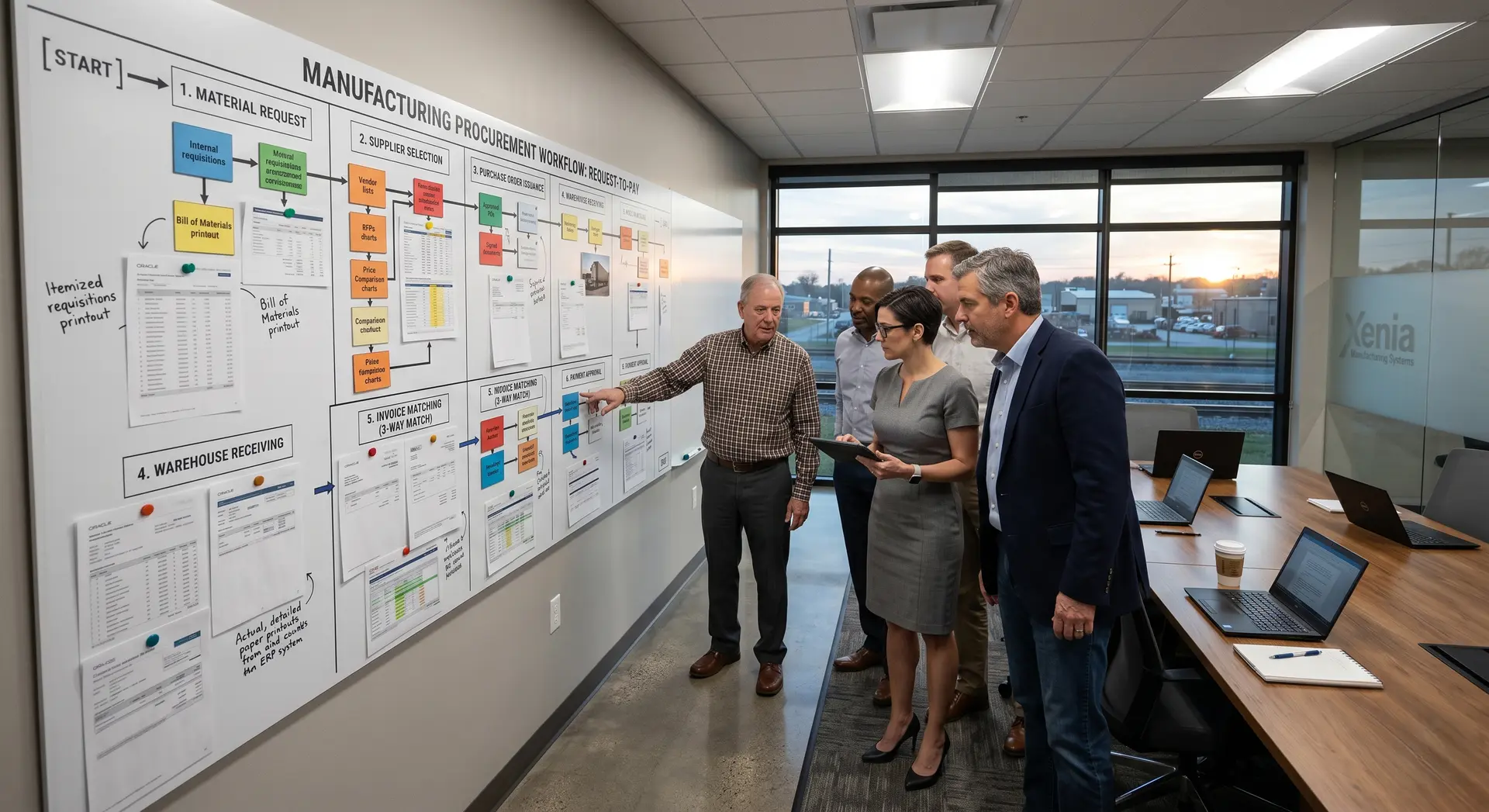
Procure-to-Pay is the integrated process that links procurement with accounts payable, covering the full lifecycle from identifying a need to reconciling the invoice and releasing payment. In manufacturing, that means the system should not only help teams buy raw materials and services, but also confirm that items were received correctly, matched to the original commitment, and paid according to approved terms.
When that lifecycle is fragmented, leaders lose visibility in two places at once. Operations cannot trust inventory and purchasing data, and finance cannot trust liabilities, due dates, or cash forecasts. A strong P2P process solves both problems by creating one auditable chain of record across warehouse activity and financial execution.
The seven pillars of P2P
Most mature P2P frameworks follow the same basic sequence: identify the need, create a requisition, select the supplier, issue the purchase order, receive the goods or services, match the invoice, and release payment. For manufacturing leaders, these are not just administrative steps. They are control points that protect production continuity, supplier trust, and margin.
1. Identification of need
The process starts when a department recognizes a requirement for material, parts, maintenance, or services. In well-run environments, this is driven by demand signals, production schedules, reorder rules, or MRP logic rather than panic buying after a shortage hits the floor.
2. Requisition request
The requisition formalizes who is requesting the purchase, what is needed, why it is needed, and which budget or approver is responsible. This step is essential for enforcing approval discipline and reducing unauthorized or “maverick” spending.
3. Supplier selection and validation
Once a request is approved, procurement selects the best-fit supplier based on price, reliability, contract alignment, lead time, and compliance requirements. In 2026, supplier choice is also a resilience decision because weak vendor management increases exposure to delay, quality, and continuity risk.
4. Purchase order issuance
The purchase order turns internal intent into a formal external commitment. It establishes the agreed quantity, pricing, terms, and delivery expectations that the supplier fulfills against and that AP later uses as a matching document.
5. Receiving goods or services
Receiving is where the physical transaction meets the system record. If warehouse teams delay receipts or enter incomplete information, inventory accuracy drops and finance loses the evidence it needs to validate invoices and liabilities.
6. Three-way match
This is one of the most important controls in the entire cycle. The invoice is compared against the purchase order and the receiving record before payment is approved, helping prevent overpayment, duplicate payment, or payment for goods that were never received.
7. Invoice approval and payment
Once the match is complete or any exceptions are resolved, the invoice moves into approval and payment. At this point, leadership should have real-time visibility into approved liabilities, due dates, and discount opportunities so payment timing becomes strategic rather than reactive.
Get Your Free Odoo Implementation Checklist
Why manual P2P creates friction
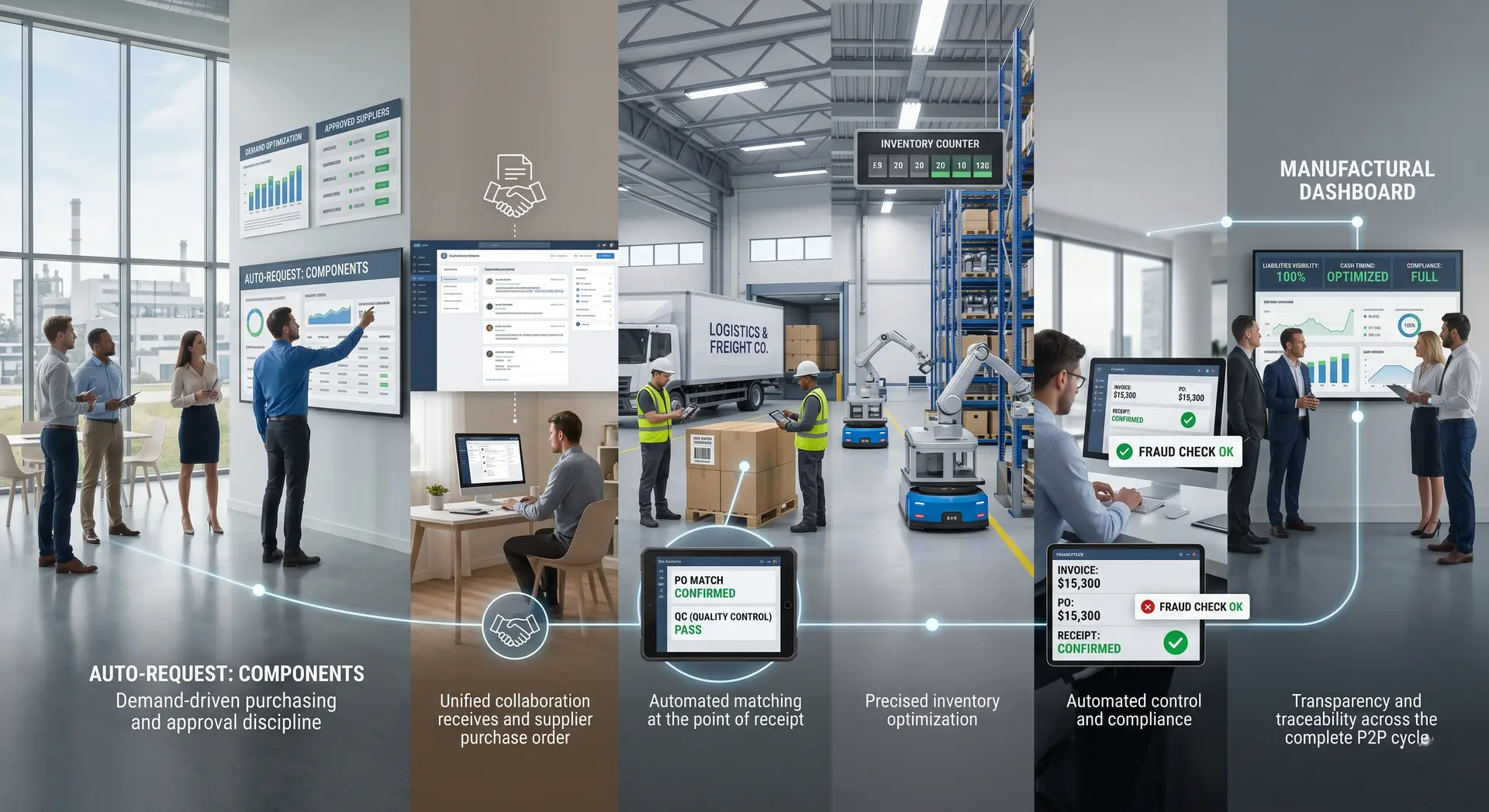
Manual P2P processes often fail in the transitions between departments. A buyer may issue a PO by email, the warehouse may receive the goods without entering the receipt promptly, and AP may receive an invoice that cannot be matched cleanly. What looks like a small delay at each step compounds into payment backlogs, inaccurate inventory, weak forecasting, and supplier frustration.
This is why automation is no longer just an efficiency upgrade. According to OpenText, digitized P2P processes improve visibility, strengthen compliance, and unify collaboration across stakeholders. Basware similarly emphasizes that effective P2P depends on end-to-end transparency, traceability, standardized workflows, supplier engagement, and inventory optimization.
For manufacturers, the operational impact is direct:
- Better demand-driven purchasing and fewer emergency buys.
- Stronger approval discipline and less off-contract spend.
- Faster PO creation and cleaner documentation.
- More accurate inventory and fewer receiving-related exceptions.
- Stronger fraud and overpayment controls through automated matching.
- Clearer visibility into liabilities and cash timing.
Why this matters in 2026
Manufacturing leaders are operating in an environment where supplier reliability, speed, and visibility matter more than ever. Current procurement guidance emphasizes automated routing, approved suppliers, policy-driven buying, and invoice matching as practical ways to reduce manual effort while improving data accuracy and control. That shift reflects a broader reality: companies can no longer scale on spreadsheets, inbox approvals, and siloed records.
In that context, the goal of P2P is not simply faster invoice processing. The goal is to create a single operating model that ties warehouse activity to financial truth. If the business knows what it needs, what it ordered, what actually arrived, and what should be paid, it can make better decisions about working capital, supplier strategy, and growth.
Odoo vs. NetSuite in the P2P conversation
Both Odoo and NetSuite can support a stronger P2P process, but the right fit depends on the complexity of the operation. Companies with lighter process complexity, tighter budgets, or a need for flexibility often lean toward Odoo, while organizations with broader reporting, multi-entity needs, or more complex financial requirements often evaluate NetSuite more seriously. The better question is not which platform is more popular, but which one can enforce the right controls across requisitions, purchase orders, receiving, AP matching, and reporting inside the business.
That is where implementation quality matters. Software only closes the warehouse-to-wallet gap when workflows are designed properly, vendor and item data are clean, and teams are trained to use the system consistently. A CPA-led implementation approach helps ensure that operational design and financial logic stay aligned from the beginning.
A practical takeaway for manufacturing leaders
If the warehouse is full but cash still feels constrained, the problem may not be demand. It may be friction inside the Procure-to-Pay cycle. The first step is to assess where handoffs are breaking down: need identification, approvals, vendor control, PO discipline, receiving accuracy, three-way match exceptions, or payment visibility.
From there, the path becomes clearer. Standardize the workflow, automate the approvals, tighten receiving discipline, and connect AP to the same system of record used by procurement and operations. That is how manufacturers move from reactive buying and cash uncertainty to a more scalable, audit-ready operating model.
Book Your Strategy Session with InSphere Consulting Today