Why Your Roofing Jobs Are Profitable on the Roof but Not on Paper
By InSphere Consulting | Business Systems & Operations Advisory for Field-Based Contractors
You've got crews working. The schedule is full. Jobs are closing. And somehow, when you sit down with your financials, the numbers don't match what you know is happening in the field.
This isn't a fluke. It's one of the most consistent patterns we see at InSphere Consulting when working with roofing companies in a growth phase and it rarely has anything to do with how well the work is getting done.
The Margin Problem That Hides in Plain Sight
Roofing is a thin-margin business by nature. Net margins typically run between 6% and 12%, even when gross margins look healthy at the estimate stage (Roofr, 2025). That's a narrow window. It means a single job can look like a winner on paper and still lose margin by the time labor overruns, material variances, and subcontractor invoices are fully reconciled.
The estimate is rarely the problem. The problem is everything that happens between the estimate and the final number.
In most operations we work with, the core issue is the same: labor hours, material usage, and subcontractor costs aren't being captured while the job is happening. They're being pieced together afterward by someone in the office working from job notes, supplier invoices, and crew texts, sometimes days later. By the time the full picture comes together, the job is done and the margin problem is already locked in.
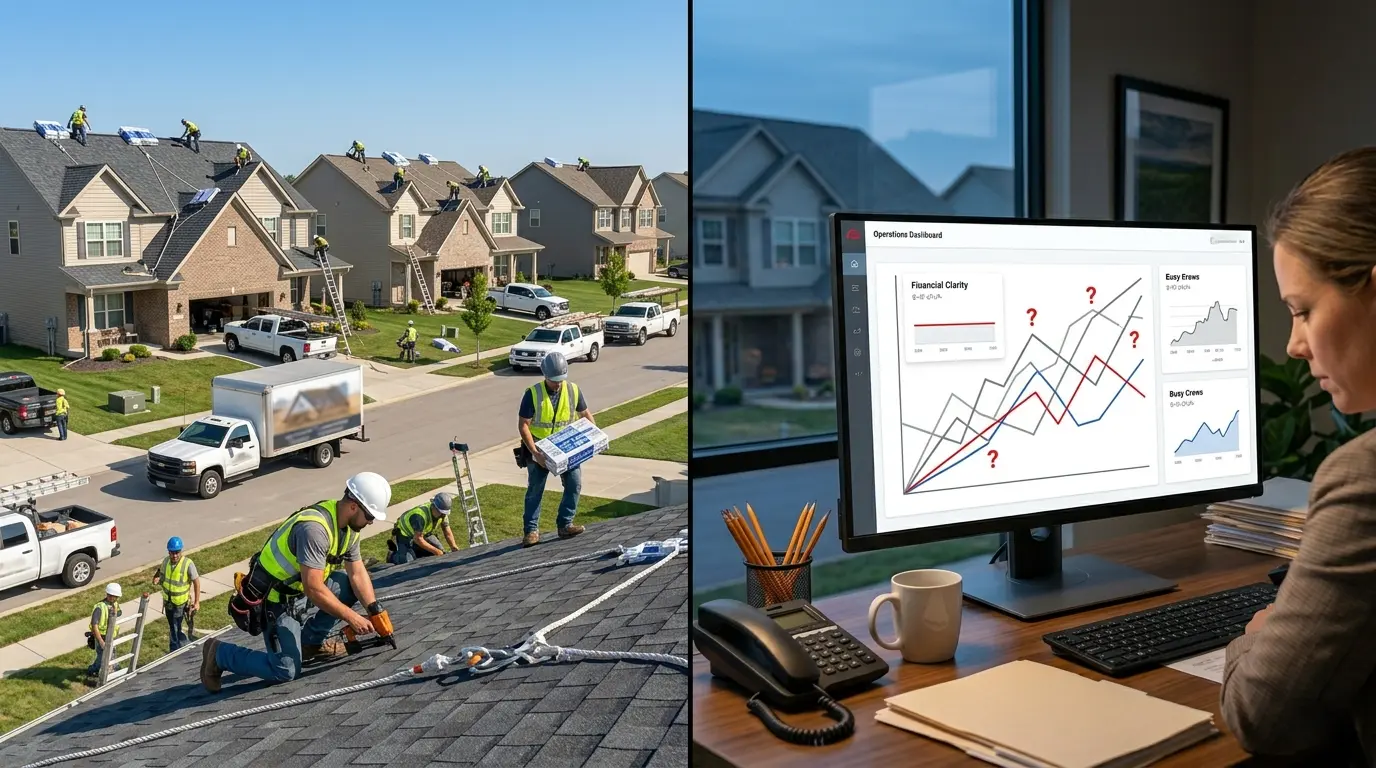
Where the Disconnect Actually Shows Up
This isn't abstract. It surfaces in three specific ways that owners deal with constantly.
Labor that can't be traced cleanly to a job. Roofing crews rarely work a clean eight-hour shift on a single site. They start a job, hit a weather delay, shift to another property, come back. Travel time, setup, cleanup, and unplanned interruptions all eat into the day. When hours are reconstructed after the fact or tracked across disconnected tools it becomes nearly impossible to know how much time actually went into each roof. One job looks profitable because it absorbed fewer hours on paper. Another quietly absorbs cost it didn't generate. Over time, these small miscalculations compound into a distorted picture of which jobs, crews, and project types are actually making you money.
Materials that move faster than the paperwork. Extra bundles get ordered mid-job. Deliveries get redirected. Materials get borrowed from one site to cover a shortage on another. These are normal field realities not problems on their own. The problem is when crews aren't logging what's used in real time, so the office is working from incomplete data until supplier invoices arrive, sometimes weeks later. On insurance restoration work especially, where material quantities are directly tied to billing and supplements, this lag creates both accuracy and cash flow problems.
Profitability discovered too late to do anything about it. When field activity and accounting aren't connected, the office ends up doing intensive reconciliation after every job verifying hours, matching subcontractor invoices to projects, sorting out materials before billing can begin. That backlog doesn't just create busywork. It delays invoicing and pushes cash further out. According to research from PBMares CPAs, 82% of contractors now face payment waits of more than 30 days up from 49% just two years earlier (PBMares, 2024, citing Rabbet's 2024 Construction Payments Report). When billing, job costing, and reconciliation all happen after the fact, margin problems are discovered long after there's anything you can do about them.
These aren't people problems. They're process and system gaps that get louder and more expensive as your volume increases.
Why Adding More Tools Usually Makes It Worse
When gaps like these show up, the instinct is to add software. A scheduling app here, an estimating platform there, a crew check-in tool for the field. These additions are well-intentioned. But when they don't talk to each other, the problem doesn't go away it spreads across more platforms.
Now the same information lives in three places, and someone still has to reconcile it manually. The office burden doesn't decrease. It just shifts.
The meaningful change happens when field activity and financial data run from the same system not patched together through exports and workarounds, but genuinely unified so that what gets logged on the roof flows directly into job costing, billing, and reporting without anyone re-entering or verifying it.
[Get Your Free Odoo Implementation Checklist]
What Changes When the System Actually Works
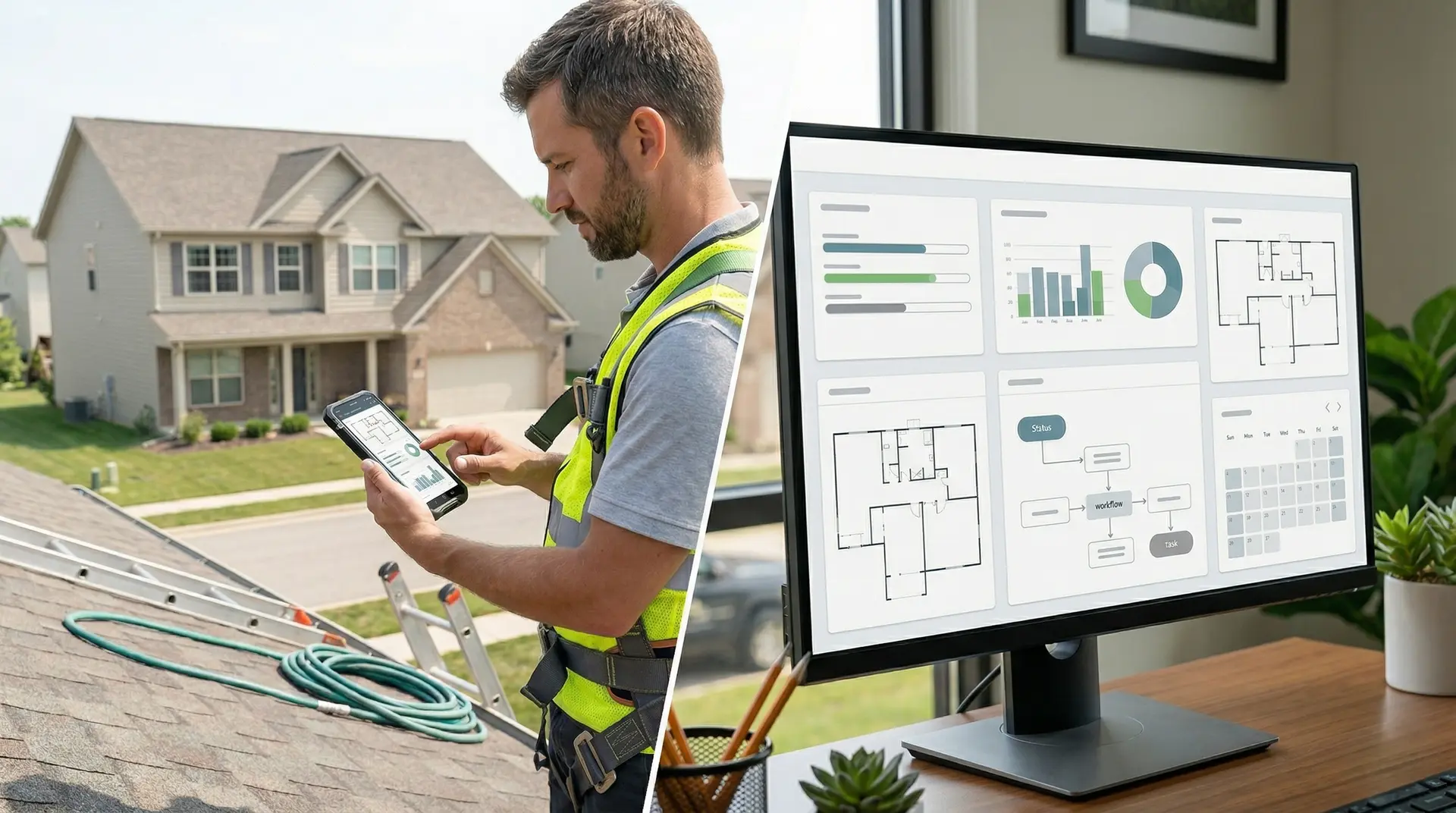
When operations and accounting share a single source of truth, the business runs differently in ways that matter on a practical level.
You can see job cost while work is still in progress. When crews log hours, materials, or subcontractor work on-site, that data flows directly into job costing in real time. Instead of waiting until end of week or discovering a problem when you're reconciling the next wave of jobs you can see whether a project is trending over on labor or materials while there's still time to act. That's a fundamentally different management posture.
Your processes hold up regardless of crew, season, or volume. A standardized system means information comes in the same way every time regardless of who's on the job or how fast you're onboarding. That consistency matters more than most owners realize. The Associated General Contractors of America's 2025 workforce survey found that 92% of contractors report difficulty finding qualified workers, and 45% say labor shortages are actively causing project delays (AGC, 2025). When finding and keeping people is already a constant challenge, any system that reduces confusion, rework, and training time has direct operational value not just administrative value.
Billing happens faster because the data is already there. When a job is completed and verified in the field, the office isn't starting from scratch to build an invoice. The information already exists in the system. That shortens the gap between work finished and cash received and, in a business, where crews can complete a roof long before payment arrives, that difference compounds across the season.
Cost overruns surface during the job, not after. With real-time visibility, margin issues show up while you still have time to course-correct. That's the difference between adjusting and absorbing.
A Honest Self-Check
Four questions that will tell you quickly whether your systems are keeping pace with your operations:
- Can you match labor hours to specific jobs without digging through multiple systems or spreadsheets?
- Do your field teams and accounting team see the same numbers when reviewing a job?
- Are material costs tied to each project as work happens, or only once invoices arrive?
- Is invoicing being delayed because someone has to verify information after the fact?
If any of these land as "not really" or "it depends," those gaps are already costing you. They're just quiet about it.
The Bigger Picture
The roofing companies that scale well aren't always the ones with the most technology. They're the ones whose systems actually reflect how their crews operate in the field.
That alignment is harder to achieve than it sounds, and the industry numbers explain why. Research from the Federal Reserve Bank of Richmond found that construction labor productivity fell by more than 30% between 1970 and 2020, while overall U.S. economic productivity doubled over the same period (Richmond Fed, 2025). That gap reflects decades of manual coordination, disconnected processes, and systems that weren't built around how field-based work actually happens.
Closing that gap is exactly what we work on at InSphere Consulting. When operations and accounting are aligned, financial reporting becomes a live view of your business not a reconstruction of it. You can price more confidently, take on more volume, and make decisions based on what's happening now, not what happened three weeks ago.
Storm season doesn't wait for your systems to catch up.
Ready to find your gaps? Book a System Health Check with InSphere Consulting and we'll show you exactly where your field-to-finance disconnect is and what it's likely costing you.

[Schedule a System Health Check]
InSphere Consulting works with field-based businesses to align operations and financial systems so growth doesn't outpace visibility. Our engagements with roofing contractors span residential replacement, insurance restoration, and commercial work.
Sources
- Roofr — How Profitable is the Average Roofing Business? (2025) — roofr.com
- PBMares CPAs — Accounts Receivable in Construction: Cash Flow at Risk Amid Payment Delays (2024), citing Rabbet's 2024 Construction Payments Report — pbmares.com
- Associated General Contractors of America — Construction Workforce Shortages Are Leading Cause of Project Delays (August 2025) — agc.org
- Federal Reserve Bank of Richmond — Five Decades of Decline: U.S. Construction Sector Productivity, Economic Brief No. 25-31 (August 2025) — richmondfed.org